The short answer
Punnett-square reasoning and the probability skills behind Section III genetics.
Written and checked by GAMSAT tutors — not AI-generated.
Try the reasoning style
We treat forgetting as a failure — a lapse to be patched with reminders and records. Yet a mind that kept everything could not think; it would drown in the undifferentiated noise of every moment it had ever lived. To forget is not so much to lose information as to decide, mostly without our noticing, what was never worth keeping.
The author's argument relies most directly on which unstated assumption?
Pick an option to see how the tutor reasons to the answer — not just whether you were right.
Not quite — the answer is B.
Work backwards from the conclusion: a mind that ‘kept everything’ supposedly ‘could not think.’ That only follows if thinking means leaving most of experience out — so B is the premise the argument quietly rests on. A raises reliability, which the passage never weighs; C contradicts ‘mostly without our noticing’; D smuggles in a claim about intellect the passage never makes. The question rewards finding the hidden premise, not recalling a fact.
Genetics questions reward clear probability reasoning, not memorised pedigrees. Master the monohybrid cross and you can handle most of what Section III throws at you.
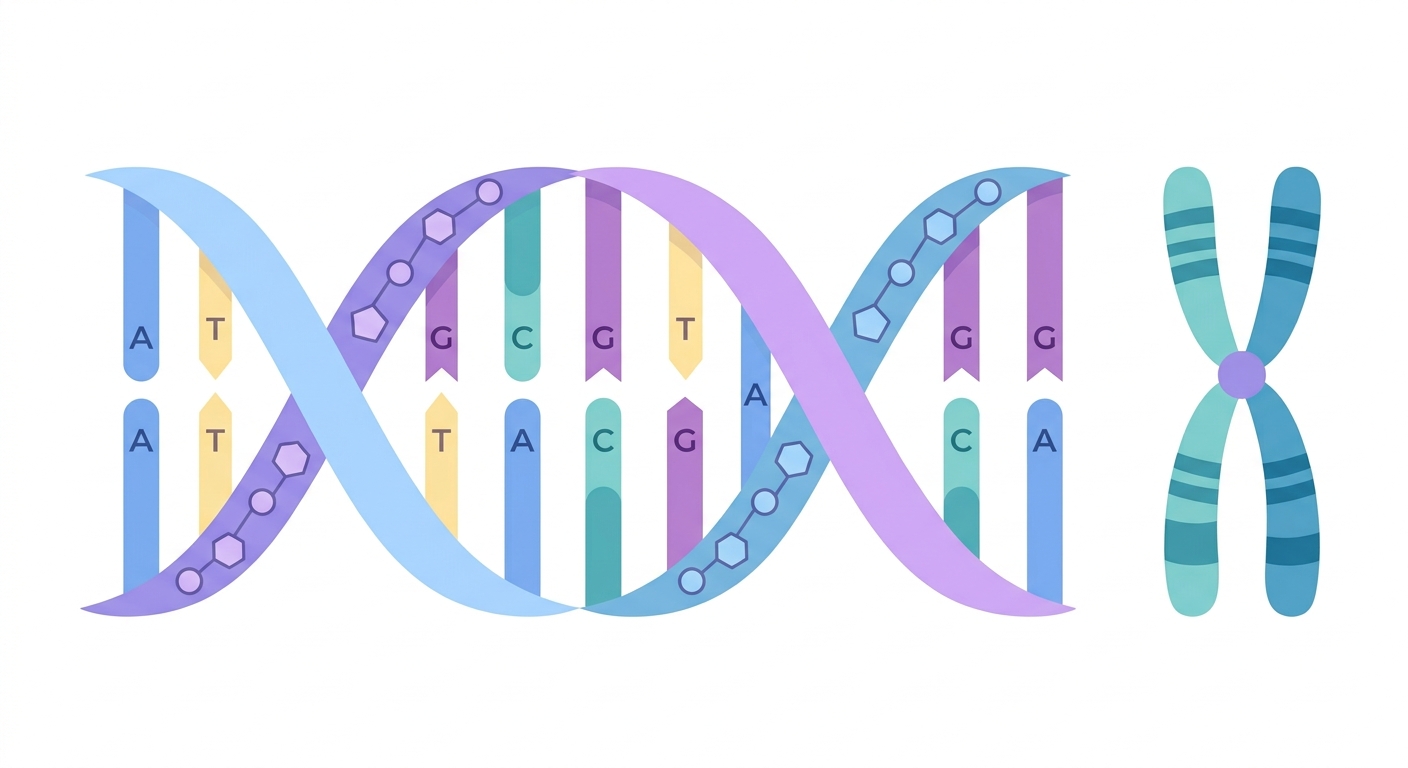
The vocabulary that unlocks it
Genotype is the allele pair (e.g. Aa); phenotype is the trait you see. A dominant allele (A) masks a recessive one (a) — so only aa shows the recessive trait.
Worked monohybrid cross
Two heterozygous parents (Aa × Aa) have a child. What's the chance the child shows the recessive trait?
AND multiplies, OR adds
Most genetics mistakes are probability mistakes, not biology mistakes — so decide which word the question uses before you calculate. AND (both things happen) → multiply: the chance that two children of Aa × Aa both show the recessive trait is ¼ × ¼ = 1/16, not ½. OR (either happens, and they cannot both happen) → add. Then check your fractions sum to 1.
When it is not simple dominance
Incomplete dominance
The heterozygote is intermediate — red × white gives pink. Three phenotypes instead of two, so the 1:2:1 genotype ratio is also the phenotype ratio.
Co-dominance
Both alleles are expressed fully and separately in the heterozygote — the AB blood group, not a blend.
X-linked recessive
Males are XY, so a single recessive allele on their one X is enough to show the trait — there is no second copy to mask it. That is why X-linked recessive conditions affect males far more often, and why an affected son can have parents who show nothing.
Check yourself
In a cross Aa × Aa, what fraction of the offspring are expected to be carriers (heterozygous, Aa)?
The paper does not tell you which pattern of inheritance you are looking at. It gives you cross data and expects you to read the pattern out of the counts. Below is that shape.
Passage· 3 questions on it
The following is adapted from a breeding study of a beetle. The species is not one you are expected to have met.
| Cross | Parents | Offspring counted |
|---|---|---|
| 1 | scarlet female × cream male | 122 apricot |
| 2 | apricot female × apricot male | 61 scarlet, 118 apricot, 59 cream |
| 3 | apricot female × cream male | 96 apricot, 94 cream |
| 4 | dark-eyed female whose own father was pale-eyed × dark-eyed male | 104 dark-eyed females, 52 dark-eyed males, 49 pale-eyed males |
Q1 of 3 on this passage
Crosses 1 and 2 together are best explained by
Q2 of 3 on this passage
Two apricot beetles from cross 2 are mated. What is the probability that their first two offspring are both scarlet?
Q3 of 3 on this passage
Which explanation best fits the offspring counts in cross 4?
Key takeaways
- Genotype = the alleles (Aa); phenotype = the visible trait.
- A recessive trait shows only when both alleles are recessive (aa).
- Aa × Aa gives a 1:2:1 genotype ratio and a 3:1 phenotype ratio.
- Treat each parent's allele as an independent 50/50 — it's just probability.
Practise this with real GAMSAT-style questions
A timed diagnostic, real practice questions with worked explanations, and your first essay marked on our rubric built from ACER's two published criteria.